
When Everyone Has Information, What Becomes the Real Advantage?
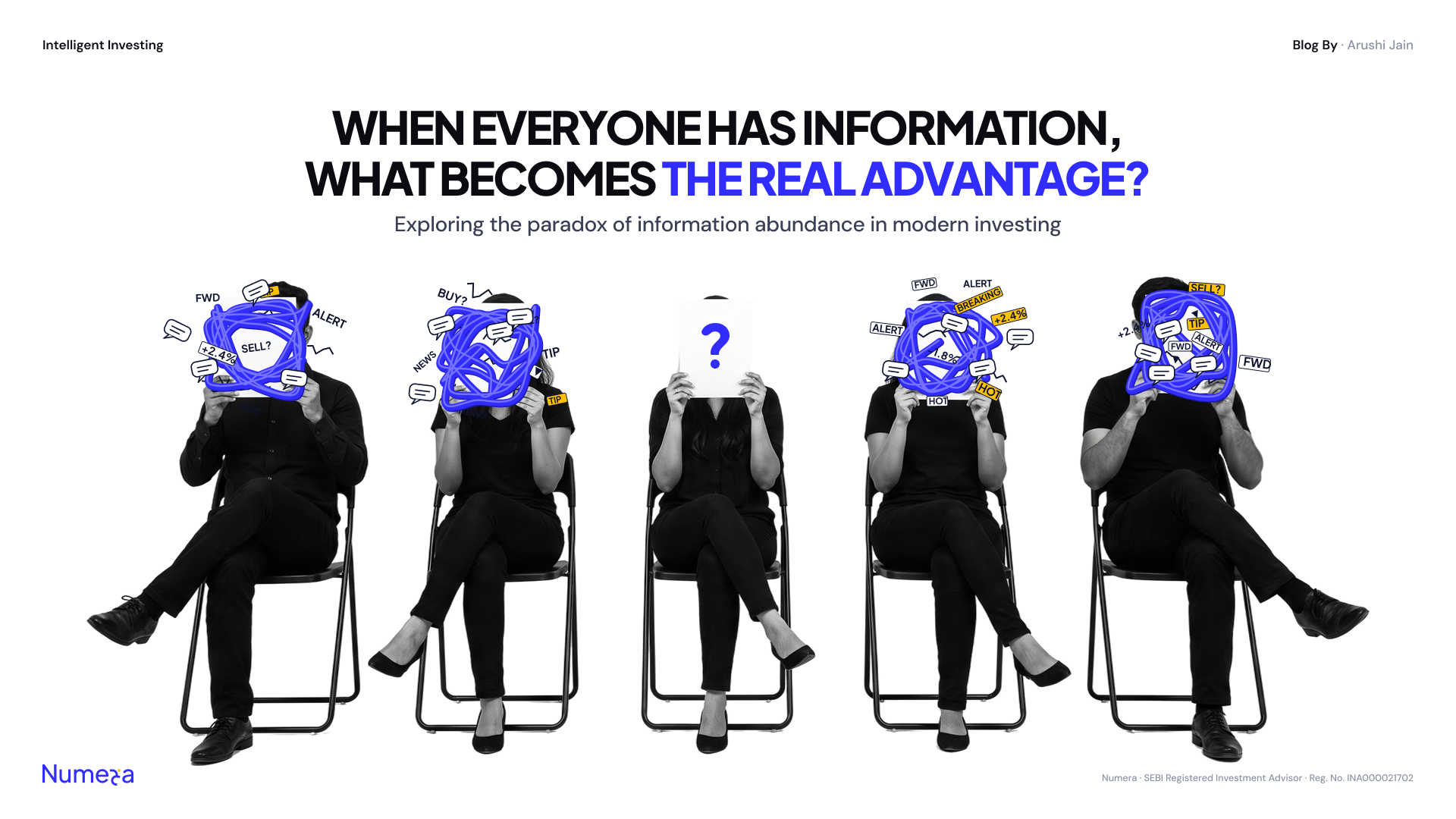
Exploring the paradox of information abundance in modern investing
In November 2023, a million tokens of GPT-4-grade intelligence cost about $60. By January 2026, the same level of intelligence cost about $0.05, a fall of more than 99.9%.
India’s affluent investors became the most enthusiastic AI users in the world. In HSBC’s survey, 86% use AI for finance and investing, the highest among all markets surveyed and well above the 73% global average. AI also makes 64% of them more willing to take investment risks.
Now put that next to another number.
Among traders active throughout FY22–FY26, only 0.5% were profitable in all five years, while 65.6% lost in every year.
Read them together. In three years, the cost of knowing things plummeted by a factor of over a thousand. Indian Investors absorbed that knowledge faster than almost anyone else, and it made them bolder, agnostic of market pulses. Yet most people who traded on that knowledge still struggled to make meaningful profits. If information or data insights were the bottleneck, those stats would have complemented each other.
I believe that up until last year, knowing something before everyone else could still give you a meaningful advantage. You knew where to look. You had access to research. You could connect developments that others were yet to notice. Finding that information took effort, and that effort had value.
Today, much of that work can happen before you finish a cup of coffee.
Ask an AI tool about a company, and it can give you an analysis. Ask it to compare mutual funds, explain an economic development or review an investment idea, and you will usually get a well-written response within seconds.
I find that remarkable. I also find myself wondering what happens after we receive the answer.
Do we understand the decision better? Or do we simply feel better equipped to make it?
These are different things, especially when money is involved.
The thrust of Artificial Intelligence has pushed all of us to the same level when it comes to accessing the information but the coagulation of thoughts and information cloud has entangled things more than before, leaving us at the bay of uncertainty, i feel.
There is an interesting case researched by Gur Huberman and Wei Jiang who found that retirement plans offering more fund choices were associated with a lower probability of employee participation. The study concerned investment choices, rather than AI-generated information. But it challenges the assumption that expanding what people can consider necessarily makes action easier.
More options introduce comparison costs. More information introduces interpretation costs. When those costs become overwhelming, a recent return, a familiar company or a compelling narrative can become a shortcut. And when those shortcuts are wrapped in convincing explanations, they become harder to ignore.
Information overload can make the loudest fact feel like the most important
A reasonable concern in the age of AI investing is that polished explanations could make those shortcuts feel more analytical than they really are. An investor might read a convincing summary and mistake clarity of language for strength of evidence. The explanation may be fluent while the assumptions may remain fragile.
This is the paradox of abundant intelligence – where access to answers is not the same as the ability to decide. Access to information coming to our finger tips has paved the way for diminishing cognizance. The art of discerning what truly deserves weight is somewhat shrinking within human walnuts. I strongly believe that “Now, when answers cost nothing, Decision Making becomes invaluable.” Be it investments or life, decision making is the key to unlock the door of choices and the consequences that come with them.
- Context. An algorithm can tell you how a stock performed last quarter. It cannot know that you are supporting your parents, you are building an asset underway your salary or that a 20% drawdown will cost you sleep and not just paper wealth. Your money has a meaning, and the meaning is not in any dataset. Have a context before you make your next move
- Restraint. The most valuable advice I have given in my career has often been a version of “don’t”. Don’t sell on Monday. Don’t chase the thing that tripled. Don’t add leverage because you feel clever. A tool that is built to answer will answer, but good advice knows when to say nothing. You also need to know when and till when you have to do “nothing”.
- Accountability. A chatbot can be confidently wrong without consequence. If we talk within the financial context, a SEBI-registered adviser cannot operate without accountability. I sign my name to my recommendations, and a regulator can examine them. In a world of unlimited opinions, where consequences are personal, someone who drives the contextual research for your purpose, becomes the rarest thing on the table.
Have an advisory compass which can help you clear dust on the direction signages in your life! - Trust over time. Intelligence can be delivered in one conversation. Trust is built across market cycles, in the cold months when advice looks wrong and in the hot months when it looks boring. With time, eventually you will realise that things will fall in their place till trust gets established.
When information is in abundance, context becomes more valuable
Markets change, and the technology around them changes faster, but the reasons people lose money have barely moved. They act on fear, they act on noise, and they act without a plan. We use technology aggressively but we should hold our judgment sacred.
What remains, and what grows more valuable, is a different job:
- Let machines do the reading, screening, monitoring and number-crunching, because they are better at it than any of us.
- Keep human expertise responsible for the question that sits underneath every portfolio: what is this money for, and what are you willing to live through to get there?
At Numera, this is the vision guiding how we build: a blend of Artificial Intelligence and Digital Intelligence, anchored in Human Intelligence.
What I’d ask of you
The next time an AI hands you a confident, beautifully written answer about your money, ask three things:
- Does this answer know my situation, or only the market’s?
- If this turns out wrong, who is accountable to me?
- Is it helping me act, or helping me act too much?
When intelligence is abundant, the winners won’t be the people with the most answers. They will be the ones who know which set of filtered answers should drive their decision .